
Pediatric Eye Care:
Don’t forget about the kiddos!
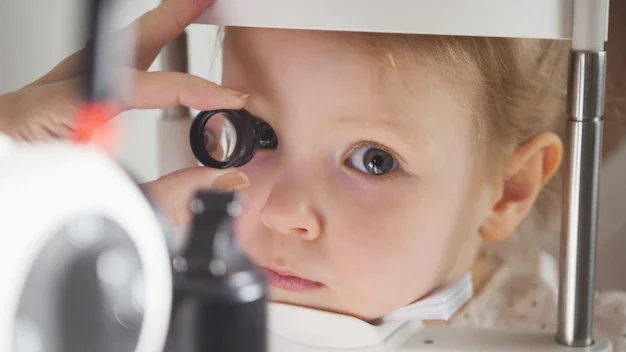
Children’s eyes can change dramatically as they grow, and that is why we recommend an annual comprehensive eye exam for children, starting as young as 6 months old! While your child will receive a nice vision screener from his or her pediatrician’s office, we provide a much more extensive pediatric eye examination that include Optos retinal imaging, refractive error, and binocular vision status. Sometimes, children require a dilated eye exam to better determine their ocular health or refractive error. Below are some of the things to be on the lookout for with your kids’ eyes and vision:
Infants and Toddlers
We see children as young as 6 months old! Through an American Optometric Association program called InfantSee, children ages 6-12 months are eligible for a completely FREE comprehensive eye exam which includes determining the child’s refractive error (ie: glasses prescription) as well as look for any risk factors for amblyopia (ie: “lazy eye”), eye turns (ie: strabismus), and even retinal conditions such as retinoblastoma. All of our providers offer this service free of charge without any reimbursement.
As your child nears school age, an exam before he or she starts kindergarten can help diagnose any ocular or visual complications that could cause difficulties with learning, such as a high refractive error (ie: glasses prescription), eye turn (ie: strabismus), or amblyopia (ie: “lazy eye”)
Amblyopia
Amblyopia, commonly referred to as "lazy eye” is when the brain suppresses vision from one of the eyes due to a disparity of vision when both eyes are open. This can be caused by, but not limited to, having big differences in prescription between the two eyes (ie: anisometropia) or an eye turn (ie: strabismus). A comprehensive pediatric eye exam can
Strabismus
Strabismus, or “eye turns” can develop for a variety of reasons. They could be congenital, or caused by different prescriptions in the child’s eyes. A comprehensive eye examination can help us determine both the severity and causation of a child’s eye turn, and we can help manage and treat the patient via therapy, patching, or surgical referral if necessary
Binocular Vision
Binocular vision refers to how well a patient uses their eyes together, and healthy binocular vision is the backbone of good reading. During each comprehensive pediatric eye exam, we check depth perception, look for eye turns, and evaluate their ability to focus reading size fonts, and monitor how well your child can point their eyes inward to read. Typically, binocular vision is not checked at a school vision screening or a pediatrician’s office screener.
Sensorimotor Exam
During the binocular vision testing of the comprehensive eye exam, we can determine if a patient has problems turning their eyes inward to read (ie: convergence insufficiency), or focusing on near work (ie: accommodative insufficiency). To further determine the severity of these conditions, we perform a sensorimotor exam which helps us test the limits of the binocular vision system. With this data, we can then formulate a treatment option for your child that may require specialty glasses only or a vision therapy course.
Vision Therapy
In some cases, children may need vision therapy to help improve their ability to converge (ie: move eyes inward) or focus at near (ie: accommodate) or both. Depending on severity, we can provide the patient with an at-home/online computer therapy. We then perform sensorimotor exams to evaluate symptoms and visual performance.